
Click the image to open the full story.
01. 200th Anniversary of St. John’s Church
This week: Why not visit our History page – All Saints Network – Our History You’d be surprised how much information is already there, not just about St. John’s, but about the churches that make up the All Saints Network, and others from the region that are now closed. Special feature: Stained Glass of St. […]
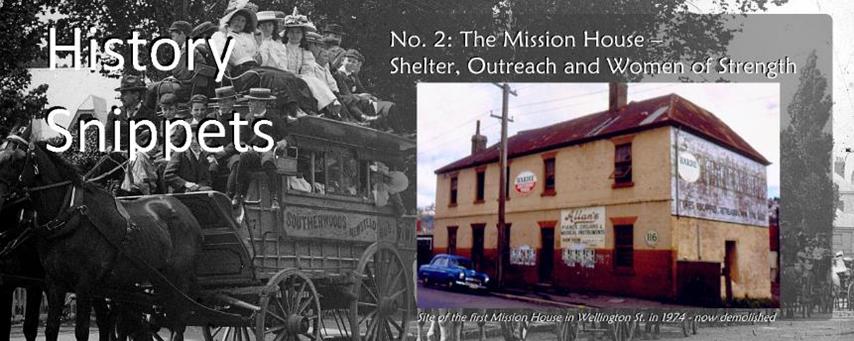
02. The Mission House – Shelter, Outreach and Women of Strength
From 1893, St. John’s reached out to the poor and vulnerable by establishing a Mission House, firstly in the former Queen’s Head Hotel in Wellington St. (now the site of Coles supermarket carpark), and then in a purpose-built centre in Canning St. opposite the Brickfields – nowadays a backpacker hostel. The early years of the […]
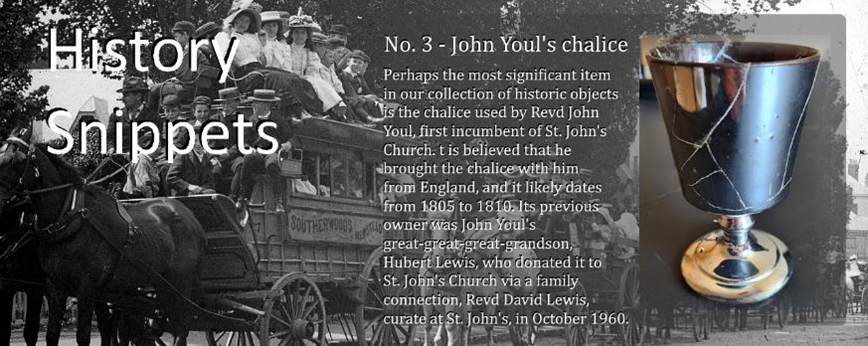
03. John Youl’s Chalice
John Youl arrived at George Town in 1819 as the first appointed chaplain for the young Port Dalrymple settlement, and St. John’s Church was built during his time, but died less than 2 years after its opening, and before it was consecrated. His story, however, includes an adventurous time as a missionary to Tahiti, involving […]
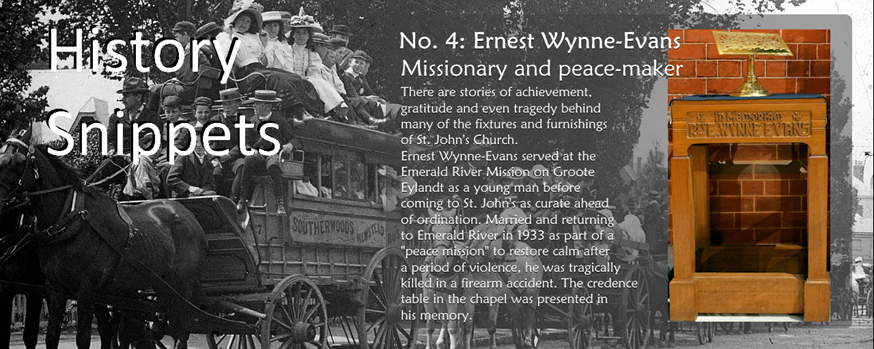
04. Ernest Wynne-Evans – Missionary and peace-maker
Born in 1905, Ernest Wynne-Evans served with Church Missionary Society (CMS) from the mid-1920s until 1929, leaving to study for ordained ministry. He served as assistant curate at St. John’s in 1931-32, and was sent out again through CMS Tasmania, becoming superintendent of the Emerald River mission on Groote Eylandt. Read of his work and […]
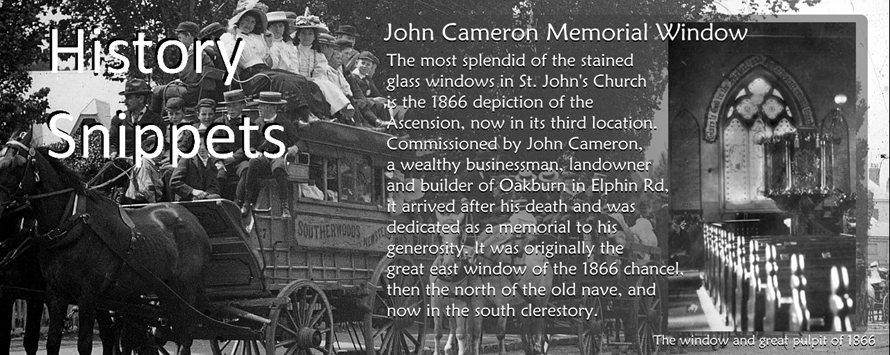
05. John Cameron Memorial Window
Arriving in Van Diemen’s Land in 1837, John Cameron was a successful businessman and landowner. He was a strong supporter of St. John’s Church, and commissioned Ferguson and Urie of Melbourne to create the beautiful Ascension window, likely Launceston’s most splendid example of the craft of stained glass making during the height of the gothic […]
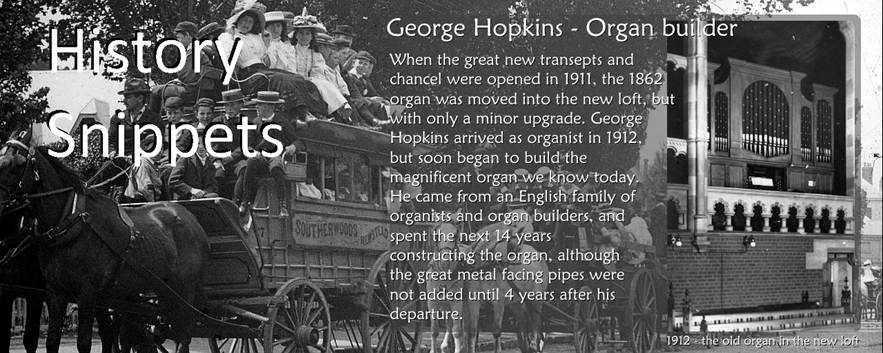
06. George Hopkins – Organ Builder
Born in 1872 in Rochester, England, to a family with strong musical traditions, organist and organ builder George Hopkins arrived at St. John’s in 1912, to find the 1862 organ, formerly in the west gallery of old St. John’s, had been moved, more or less as it was, into the cavernous new organ loft. In […]
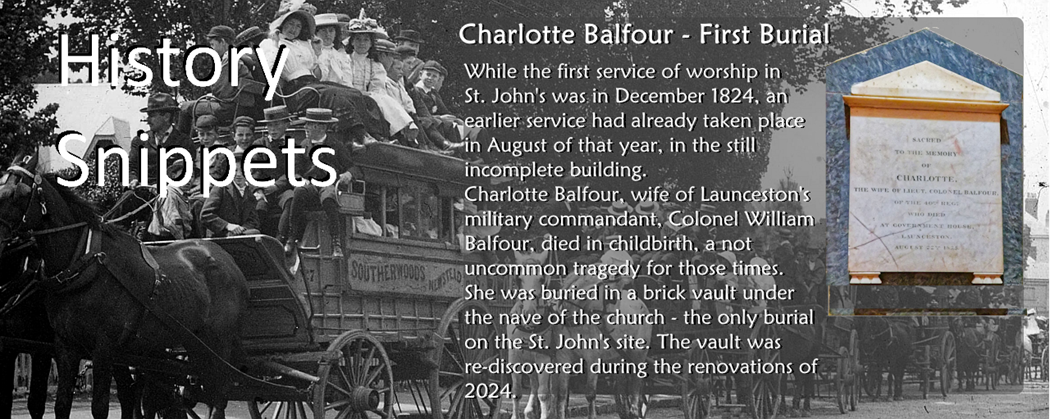
07. Charlotte Balfour – First Burial
Launceston residents will be familiar with Balfour Street, named after Lieutenant-Colonel William Balfour, who was appointed civil and military commandant of the Port Dalrymple settlement in 1825, and came to Launceston with his wife Charlotte and children in April that year. Tragically, she fell ill and died on 22nd August, aged just 33, leaving behind […]
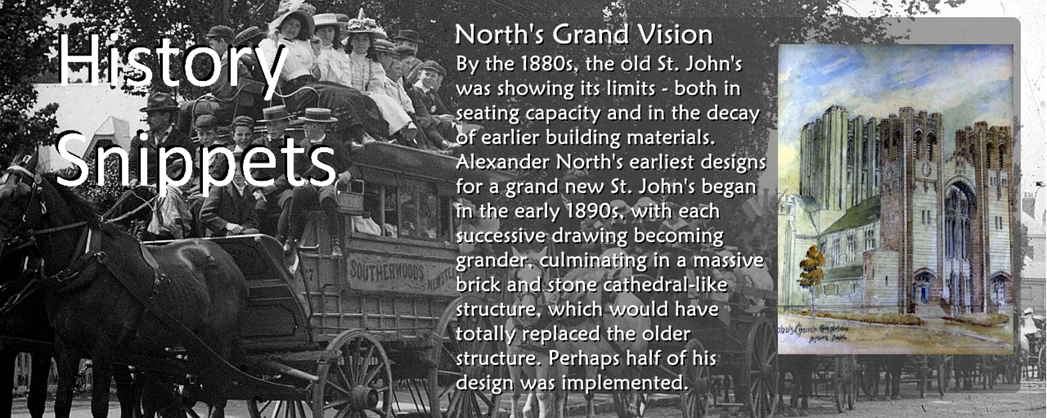
08. North’s Grand Vision
Even in the first decades of St. John’s Church, the size of the building was seen as inadequate for the growing town. A small eastern chancel, added in 1866, hardly improved the seating capacity, and by 1884, Leslie Corrie had drawn up a plan, never implemented, to double the length of the building. Corrie’s business […]
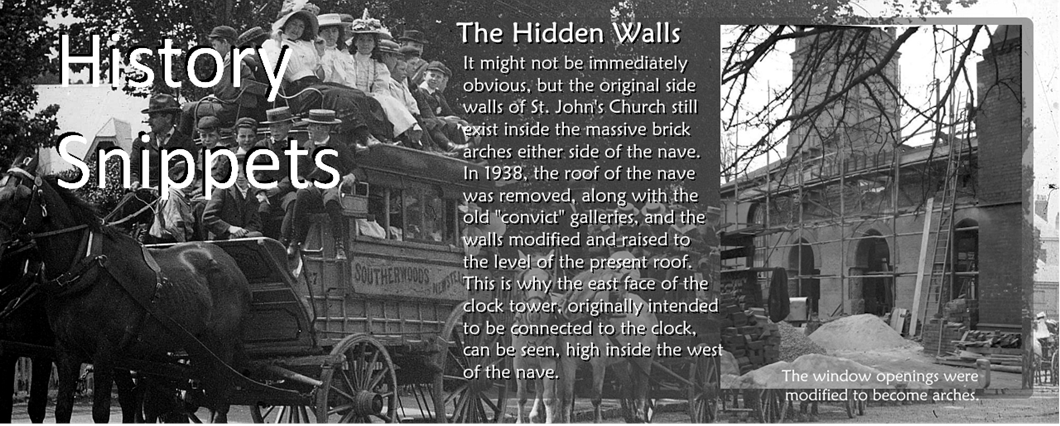
09. The hidden walls – 1938
While earlier plans for the extension of St. John’s proposed a lengthening of the building eastwards, and some felt a complete demolition was best, Alexander North’s 1893 plan included the vast dome area and transepts, the present chancel and sanctuary, the vestries and organ loft. Stage 2, implemented in 1938, would see the nave de-roofed […]
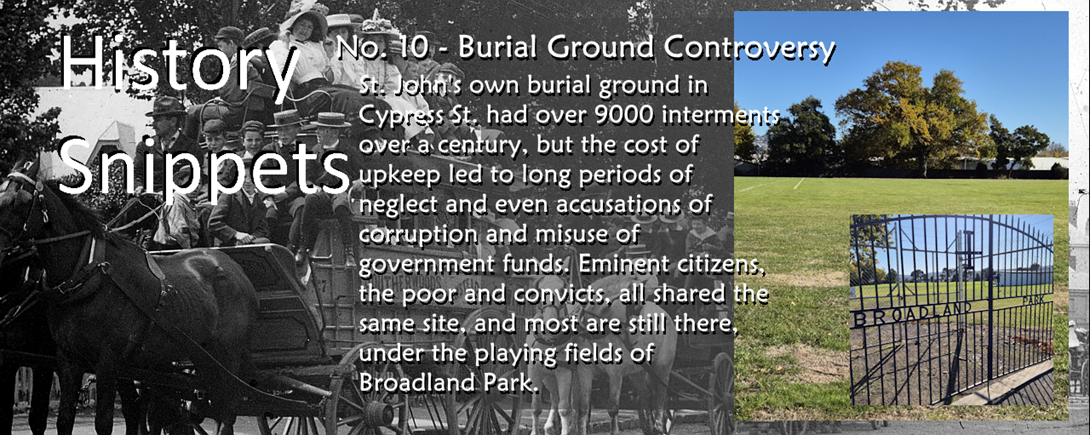
10. Burial Ground Controversy
By default, the majority of the population of colonial Launceston, convict and free, was considered “Church of England”, and the “Episcopalian Burial Ground” was consecrated in 1823 in what is now Cypress Street. An estimated 9000 people were buried there before its closure in 1929. The site apparently went through long periods of neglect, and […]
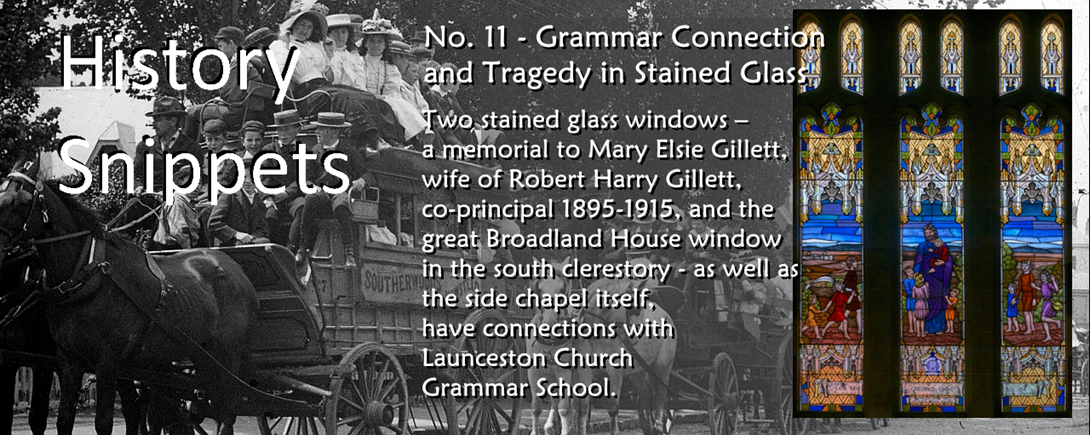
11. Grammar Connection and Tragedy in Stained Glass
Launceston Church Grammar School occupied what is now the Colonial Hotel, adjoining St. John’s in Elizabeth St, and connections with the church were historically strong. When the great “extension” was completed in 1911, the side chapel was referred to as the Grammar Chapel. As the building drew towards completion, sponsors were invited to contribute stained […]

12. Heroic Fernau – The Smallpox Epidemic
Revd Felix Albert Fernau, curate at St. John’s 1902-6, was a remarkable, if nomadic character, who made a name for himself caring for victims of epidemics and leprosy, but also worked as a missionary in New Guinea and in the outback. He was part of a group of doctors, nurses and clergy who risked their […]
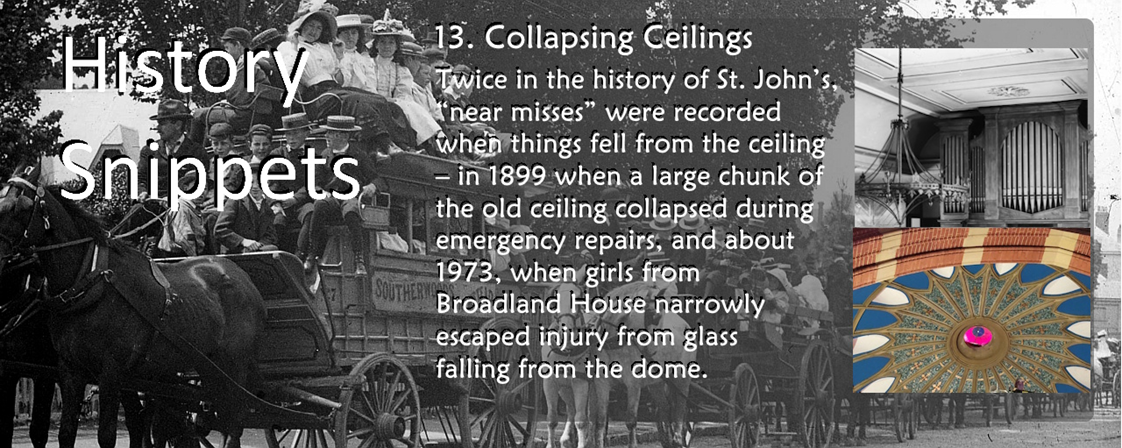
13. Collapsing Ceilings
In 1899, plans were well in hand for the building of “the great extension” of St. John’s – the present dome area, transepts, chapel, chancel and sanctuary. The nave rebuild was stage 2, and was eventually completed in 1938. But in August that year, the ceiling of the nave was found to be dangerously close […]

14. Pew Rents
We all have our preferred places to sit in church – sometimes out of habit, sometimes because it seems warmer, or the sound is better. From the early days of St. John’s, “pew rents” were a normal part of the finances of the church, and especially once the colonial government stopped funding the church in […]
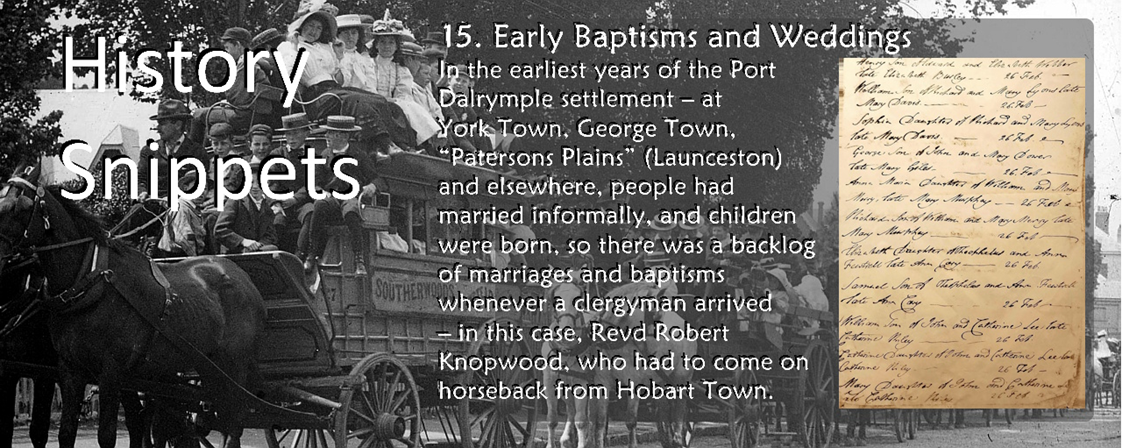
15. Early Baptisms and Weddings
Before St. John’s Church was built, and before the appointment of Revd John Youl as chaplain to the settlement, Christian ministry was haphazard and occasional. Revd Robert Knopwood was the only clergyman in Van Diemens Land from 1803, and rarely made the difficult journey north. A small portion of his records, mainly from 1811, has […]

16. The Controversial Clock
By the 1820s, early Launceston was gradually changing from a settlement of tents and huts into a small town, and with the completion of St. John’s Church in 1825, an opportunity arose to install a town clock in its tower, so all could see the time and set their own clocks and watches. The earliest […]
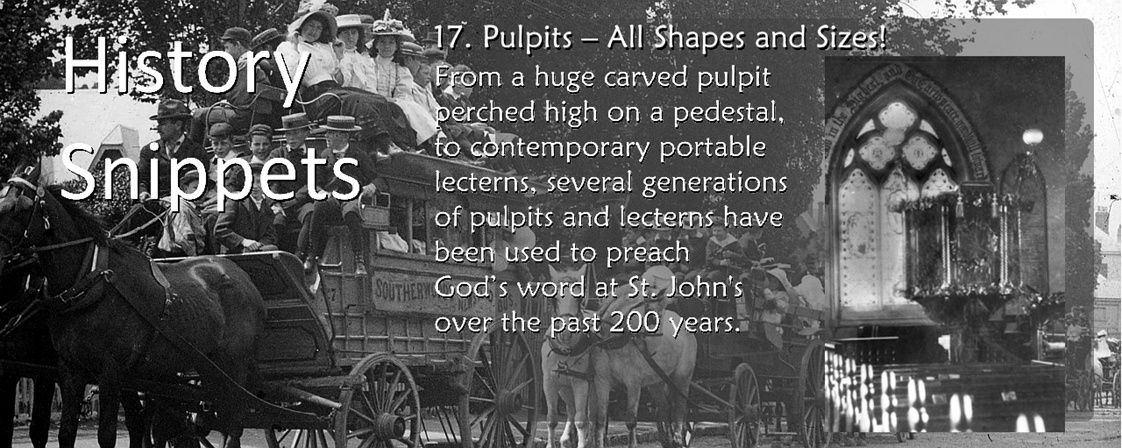
17. Pulpits – All Shapes and Sizes!
We don’t know for sure what kind of pulpit was used when St. John’s first opened in 1825. The earliest photo of the interior shows a very tall and beautifully carved pulpit on a pedestal, and it was moved from the centre to the left when the new chancel was built in the 1860s, so […]
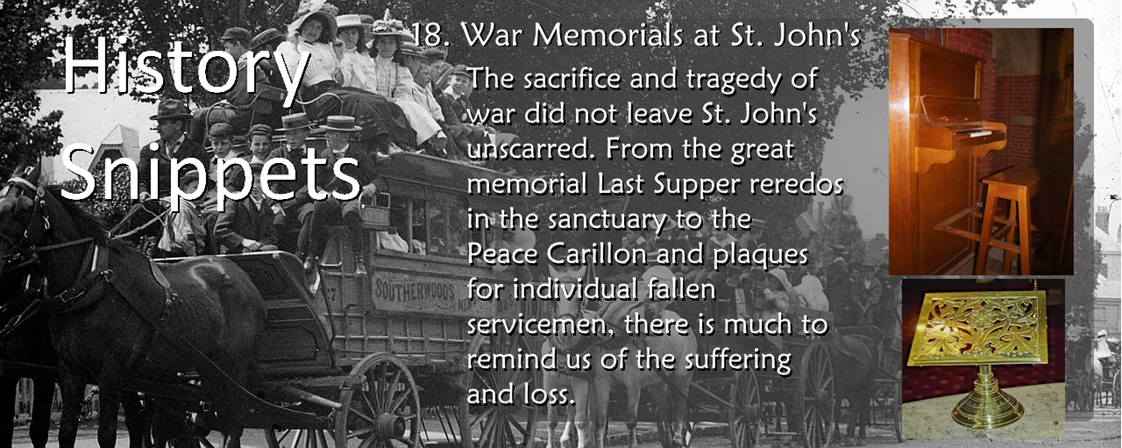
18. War Memorials at St. John’s
Inside nearly all the places of worship in Launceston and surrounding districts, there have been placed honour boards, plaques, windows and other memorials to commemorate those members of each congregation who fought and in many cases, gave their lives, in the several wars in which our countrymen have taken part. In St. John’s, there are several […]
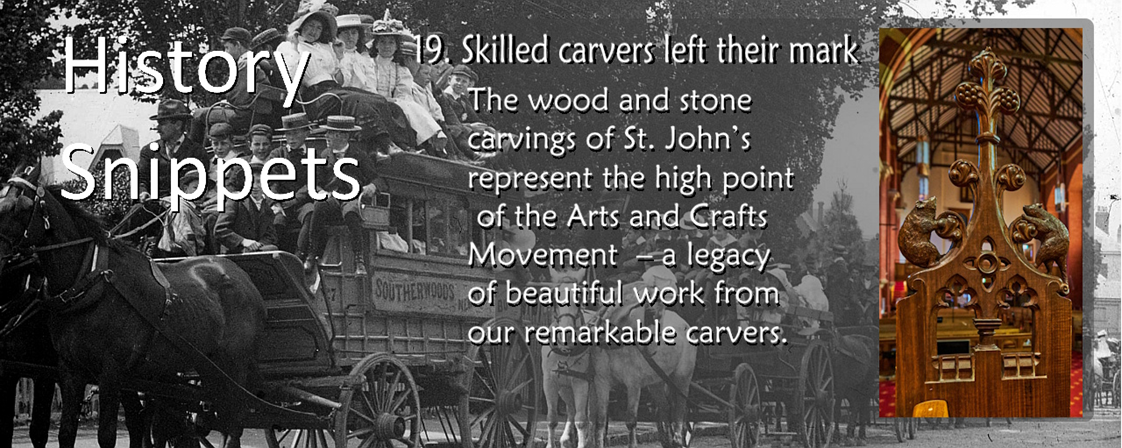
19. Gifted Carvers left their Mark
There are some remarkable carvings in St. John’s Church, and also places intended for carvings which were never completed. We have recently found a 1935 letter from architect Alexander North outlining his proposals for those protruding blocks. His ideas might seem less relevant nowadays!Four carvers made their mark at St. John’s. The choir stalls, the […]
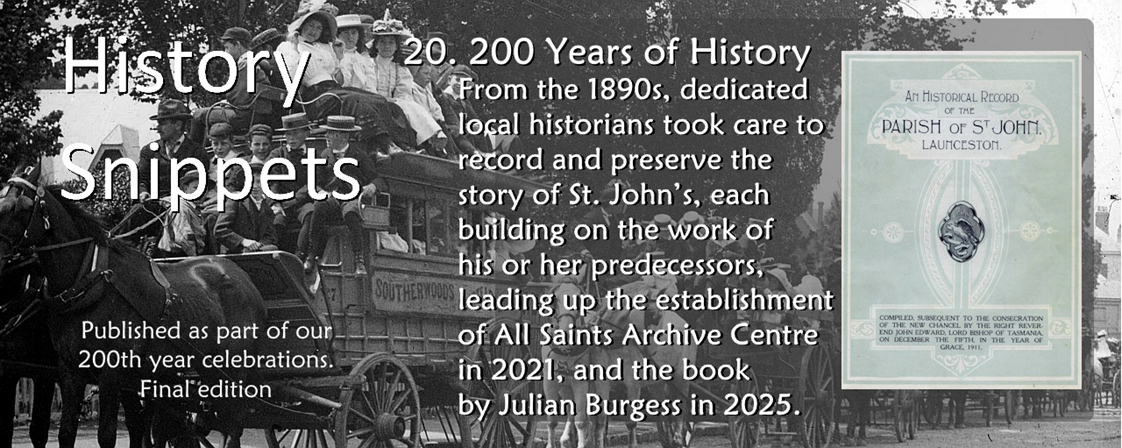
20. St. John’s Church – 200 Years of History
By the time St. John’s was 70 years old, efforts were already being made to recall and write down its history. Local historian and churchwarden Ernest Whitfeld [link] gave a talk on origins of the Mission House in 1896, and we owe the preservation of many years of Parish Messenger [link] to his personal collection. […]